- Applications
- Oral Gavage
- IV Drug Infusion
- Mouse Intermittent
- Mouse Continuous Infusion
- Mouse Continuous Infusion Plus Blood Sampling
- Mouse Two Channel Infusion
- Rat Intermittent
- Rat Continuous Infusion
- Rat Intermittent Infusion and Blood Sampling
- Rat Continuous Infusion Plus Blood Sampling
- Rat IV Bolus
- Rat Two-Channel Infusion
- Rat Infusion and Whole Body Plethysmography
- Rat GLP Infusion Toxicology Studies
- Large Animal Continuous Ambulatory Infusion
- IV Self-Administration
- Blood Sampling
- Glucose Clamp
- Bile Sampling
- Products
- Feeding Tubes
- Catheter Flush and Lock Solutions
- Catheters
- Buttons & Tethers
- Swivels & Mounts
- Tubing, PinPorts™ & Connectors
- Pumps
- Automated Blood Sampler
- Rodent Dose Puller
- Education
- Resources
Online Mouse Catheterization Training
Learn the skills, techniques and procedure for performing microsurgery in mice, all online.
Reserve Your Seat NowOverview
Conducting quality research involving catheterizations requires adherence to specific standards. We are committed to education and have assembled a complimentary library of resources to assist and enlighten you. Our free library offers the following presentations:
- Rodent Surgical Guidelines
- Surgical Instruments for Mouse Catheterization
- How to Achieve Optimal Patency Duration
- Sterile Solutions and Catheter Maintenance
When you're ready to perform the procedure yourself for the first time, or wish to refresh on existing techniques, we offer a two hour live online course featuring an in-depth video and standard operating procedure. Each course includes the following:
- Free samples: Five Vascular Access Buttons™, Five catheters, and flush solution ($275 value)
- PDF downloads of all presentations
- 90 days of full access to the course content, including a video of the procedure
- Detailed Standard Operating Procedure (SOP)
- Course Completion Certificate (course eligible for CEUs with ASR and AALAS)
Note: Enrollment fees and samples are per student. Contact us for group discount rates.
Free Video Library
A solid foundation is crucial for mastering any advanced skill, particularly rodent surgery. To maximize your online catheterization learning experience, we encourage all students to review the presentations listed below before starting their course.
Rodent Surgical Guidelines
From equipment and supplies to analgesia and anesthesia to recovery and post procedure care, this is where every microsurgeon should begin their learning.
Surgical Instruments for Mouse Catheterization
Preparing for survival microsurgery involves numerous considerations. Beyond surgical skills, possessing the appropriate tools can be crucial in determining success or failure. Read this"Guide to Surgical Instruments for Rodent Catheterization" for a general overview, and review this presentation specific to instruments for mice.
Do you need surgical instruments of your own? In collaboration with Fine Science Tools we developed a Vascular Catheterization Surgical Pack for Mice
How to Achieve Optimal Patency Duration
If you're performing survival catheterization surgeries, patency matters. There are five factors that influence patency, and this presentation succinctly walks you through each.
Sterile Solutions and Catheter Maintenance
What kind of flush solution to use? What about lock solutions? How often should you perform catheter maintenance? Whether it's a conflict of information or a lack thereof, this video gives you the tools needed to make informative decisions when it comes to what solutions to use and how to maintain the catheters.
Live Online Course
How to Perform the Catheterization Surgery
Students who sign up for our online learning program receive complete access to the course of their choice. Whether it's the jugular vein or carotid artery catheterization procedure, you'll acquire the knowledge necessary to independently perform a surgery in mice.
Course Agenda:
- Introduction: 15 minutes
- Overview and Discussion of Presentations: 30 minutes
- How to Measure Catheter Insertion Length: 15 minutes
- The Surgical Procedure with Video: 30 minutes
- Questions and Answers: 30 minutes
Upcoming Courses
|
Course |
Part Number | Date | Time (New York Timezone) |
| Mouse Jugular Vein | TRSRG-V2HR-MJVC | August 25, 2026 | 1 p.m. - 3 p.m. |
| Mouse Jugular Vein | TRSRG-V2HR-MJVC | September 30, 2026 | 9 a.m. - 11 a.m. |
| Mouse Jugular Vein | TRSRG-V2HR-MJVC | October 20, 2026 | 1 p.m. - 3 p.m. |
| Mouse Jugular Vein | TRSRG-V2HR-MJVC | November 18, 2026 | 9 a.m. - 11 a.m. |
| Mouse Jugular Vein | TRSRG-V2HR-MJVC | December 15, 2026 | 1 p.m. - 3 p.m. |
| Mouse Carotid Artery | TRSRG-V2HR-MCAC | September 10, 2026 | 9 a.m. - 11 a.m. |
| Mouse Carotid Artery | TRSRG-V2HR-MCAC | November 11, 2026 | 1 p.m. - 3 p.m. |
Scholarships Available
Great research begins with great education. To assist those who face challenges securing the funding to learn rodent catheterization, we now offer scholarships to qualified candidates.
Testimonials
"Top quality"
Andrée presents the material in an approachable and professional manner. Excellent video and PDF files, top quality. Even those with little surgical experience on rodents are able to begin confidently. She also gives so many troubleshooting and "if this happens, this is what was likely the problem" which was worth attending alone. There is no substitute for 20 years of experience on top of a sincere passion for teaching others!
- M. Barnes
Read More Testimonials
"Valuable Advice"
Andrée was very kind and answered all my questions thoroughly. She gave me valuable advice that will be useful not only for the topic covered in the course but also for surgeries in general.
- M. Rodriguez
Read More Testimonials
"Excellent Course"
I think it will be an excellent course for beginners but also for people with experience because it gives you some clues in how to improve your surgical procedure.
- C. Cardozo
Read More Testimonials
Meet Your Instructor
Andrée Lapierre, BS, LATG, CMAR, SRS
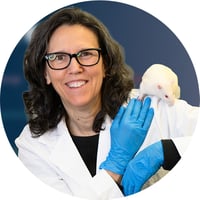 Andrée has over 30 years of experience in animal research with the past 25 years focused on rodents and surgical procedures. She worked at the Jackson Laboratory for 22 years managing the Surgical Services department for over 12 years and was an integral part of the surgical team for 21 years. She has extensive experience in training surgical procedures nationally and internationally since 2004.
